Category: Infrastructure Investing · Data Centers · AI Super Cycle
AI demand has created a dual bottleneck in physical capacity and power supply — and the companies solving both problems represent one of the defining investment opportunities of this decade.
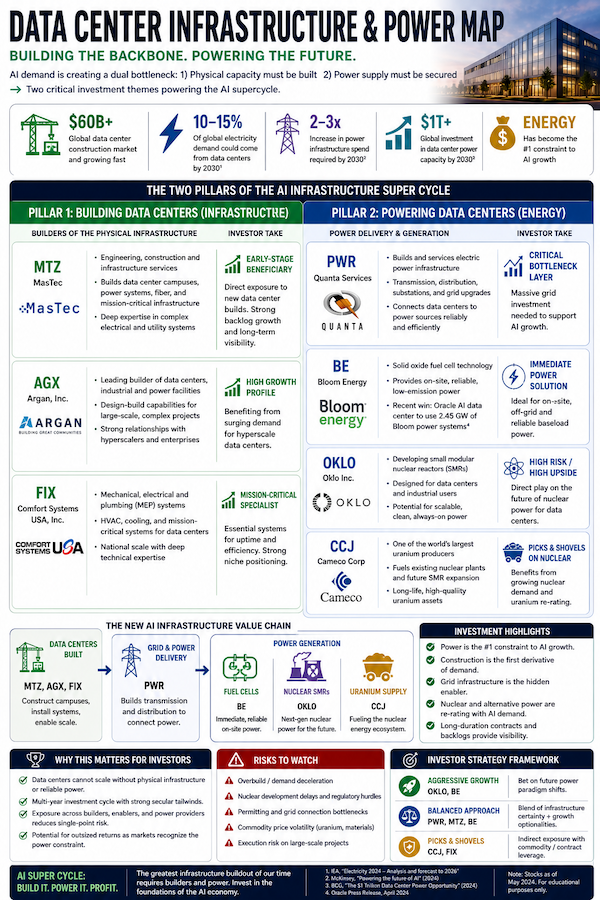
Key Statistics
| Metric | Figure |
|---|---|
| Global data center construction market | $60B+ and growing |
| Share of global electricity from data centers by 2030 | 10–15% |
| Required increase in power infrastructure spend by 2030 | 2–3× |
| Global investment in data center power capacity by 2030 | $1T+ |
When most investors think about the AI boom, they think about Nvidia, OpenAI, or the hyperscalers. But there's a quieter — and arguably more durable — investment story unfolding in the physical and electrical infrastructure that makes AI possible at all.
The thesis is straightforward: you cannot run AI models without data centers, and you cannot run data centers without massive, reliable power. Both are in critically short supply. The companies building the campuses and wiring the grid are entering a multi-year, capital-intensive growth cycle with long contract backlogs and secular tailwinds that won't reverse overnight.
"Energy has become the number one constraint to AI growth — not algorithms, not chips, not talent."
Two Pillars, One Thesis
The investment opportunity breaks cleanly into two pillars: the physical construction of data center infrastructure, and the delivery and generation of the power that runs it.
Pillar 1: Building Data Centers (Infrastructure)
Constructing the campuses, server halls, fiber networks, cooling systems, and mission-critical electrical infrastructure that hyperscalers and enterprises need at scale. Driven by surging hyperscaler capex and near-zero vacancy in existing facilities.
Pillar 2: Powering Data Centers (Energy)
Delivering and generating the gigawatts of always-on electricity these facilities demand. Includes grid upgrades, transmission build-out, fuel cells, small modular reactors, and the uranium supply chain the hidden bottleneck driving the entire AI economy.
The Stocks Worth Watching
Across the two pillars, a handful of publicly traded companies sit in structurally advantaged positions:
| Ticker | Company | Role | Investor Angle | Conviction |
|---|---|---|---|---|
| MTZ | MasTec | Data center construction & electrical | Early-stage beneficiary with strong backlog visibility | High |
| AGX | Argan Inc. | Large-scale industrial & power facilities builder | High growth from hyperscale demand surge | High |
| FIX | Comfort Systems USA | MEP systems, HVAC, mission-critical infra | Mission-critical specialist; essential for uptime | High |
| PWR | Quanta Services | Electric grid, substations, transmission | Critical bottleneck layer; massive grid investment cycle | High |
| BE | Bloom Energy | On-site solid oxide fuel cells | Immediate power solution; off-grid reliability | Moderate |
| CCJ | Cameco Corp | Uranium production & supply | Picks & shovels on nuclear; benefits from SMR expansion | Moderate |
| OKLO | Oklo Inc. | Small modular nuclear reactors (SMRs) | Direct play on future of data center nuclear power | Speculative |
Why Infrastructure Beats Picks and Shovels Hype
The "picks and shovels" framing is often applied lazily but here it genuinely holds. Unlike chip companies exposed to AI model performance cycles, or hyperscalers whose AI bets may or may not pay off, infrastructure builders get paid regardless of which AI model wins. Whether it's Google, Microsoft, or a Chinese competitor running the next frontier model, someone has to pour the concrete, run the conduit, and upgrade the substation.
Construction is the first derivative of demand. Every dollar spent on AI compute eventually requires dollars spent on physical capacity. Multi-year contract backlogs mean revenue visibility that software-driven businesses rarely enjoy. And the secular tailwind AI compute demand doubling every 12–18 months isn't going away.
The grid layer, represented most clearly by Quanta Services (PWR), is the often-overlooked hidden enabler. Data centers cannot simply plug into the existing electrical grid they require new transmission lines, upgraded substations, and dedicated interconnections. This work is capital-intensive, takes years to permit and build, and creates long-term contracted revenue streams that aren't correlated with technology cycles.
Three Portfolio Approaches
Conservative: Balanced Infrastructure
Tickers: PWR · MTZ · BE
Blend of infrastructure certainty with selective power exposure. Lower volatility, strong backlog visibility.
Moderate: Full Value Chain
Tickers: MTZ · AGX · FIX · PWR · CCJ
Diversified across builders, grid operators, and uranium supply. Captures the whole infrastructure cycle.
Aggressive: Growth + Optionality
Tickers: OKLO · BE · AGX
Bet on future power paradigm shifts — fuel cells and nuclear SMRs. Higher risk, higher upside potential.
Risks You Cannot Ignore
- Overbuild and demand deceleration. If AI capex slows — whether due to model efficiency improvements or enterprise spending pullbacks — construction pipelines could outpace actual demand.
- Nuclear development delays and regulatory hurdles. SMR timelines remain highly uncertain. OKLO and other nuclear plays carry meaningful execution risk and long development cycles.
- Permitting and grid connection bottlenecks. New transmission infrastructure faces multi-year permitting processes that can delay or derail project timelines entirely.
- Commodity price volatility. Uranium, copper, and steel are key inputs. Supply chain disruptions or commodity spikes can compress margins across both construction and energy players.
- Execution risk on large-scale projects. Complex, multi-hundred-million-dollar builds carry real operational risk — cost overruns, labor shortages, and technical failures are historical features of this sector.
The bottom line is this: the AI economy requires a physical foundation, and that foundation is being built right now. The greatest infrastructure buildout of our era is underway — and unlike the software layer above it, the infrastructure layer is tangible, contracted, and indifferent to which AI model eventually dominates. That's a durable thesis worth taking seriously.
This article is based on publicly available information and is provided for educational and informational purposes only. It does not constitute financial advice or a recommendation to buy or sell any security. Always conduct your own research and consult a licensed financial advisor before making investment decisions. Stocks mentioned as of May 2024 per original source data.